

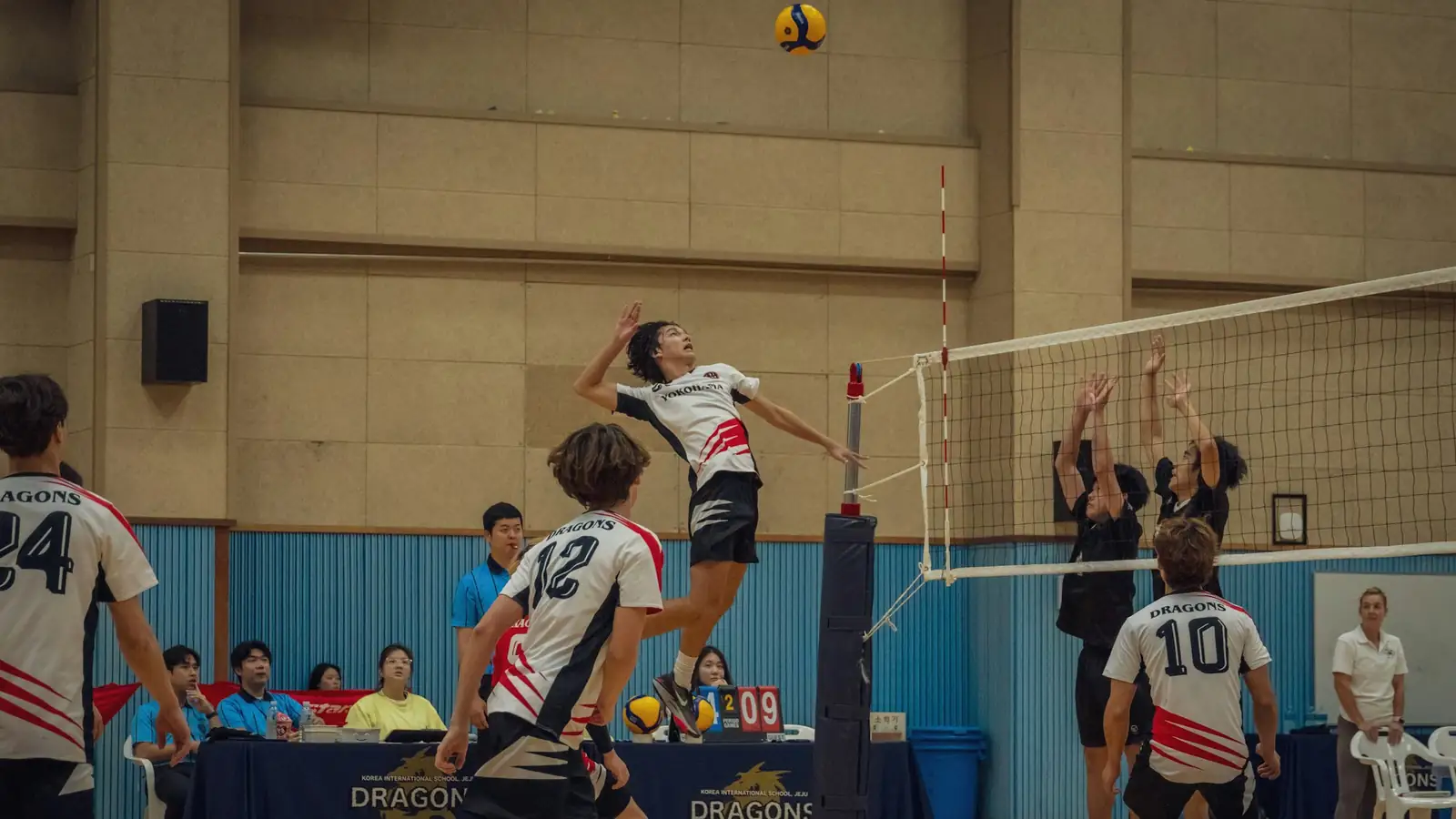
The spike is the most direct way to win a point. And it isn’t only about strength: a good approach, a well-loaded arm and hitting at the highest point matter more than hitting hard.
Spiking technique step by step
For a right-hander (left-handers, the other way round), the spike has four phases:
Approach
Three or four steps is standard; with three: left, right, left. The first sets the direction, and the last two are quick and long and brake your run to turn it into a jump. During the second-to-last step, swing both arms back to drive the jump with them.
Arm swing
At take-off, both arms rise together. The left one points at the ball and the right one loads back with the elbow high, above the shoulder, and the hand behind the head. The trunk turns slightly to the right so you can unleash the hit.
Contact
Hit at the highest point you can reach, in front of your hitting shoulder. Open, firm hand, contact with the whole palm and the wrist snapping over the ball to give it topspin. The left arm pulls down hard as the right one strikes.
Landing
Land on both feet at once with your knees bent, without touching the net or crossing the centre line. A good landing protects knees and ankles and leaves you ready for the next action.
Types of spike
Cross-court and line shots
This is the basic spike. Cross-court is the most natural shot and gives you more court; the line, parallel to the sideline, surprises when the block closes the angle. Changing direction with your trunk rotation and wrist, not just the arm, keeps the block from reading it.
Placed shot
You aim for an empty area (the deep corners, the middle of the court or the gap behind the block) with less power and more precision.
Tip
You load the arm as if for a hard spike and, at the last moment, touch the ball with your fingertips to drop it just behind the block. The rules only allow it if the ball is hit cleanly, not caught or thrown.
Tooling the block
When the block is tall, you hit the ball off the outside of the blocker’s hands so it goes out. If the ball touches the block and goes out, the point goes to the attacker.
Rules that affect the spike
Under the official FIVB rules 2025-2028 (rules 11 and 13):
- Front-row players may attack at any height, as long as they contact the ball within their own playing space.
- A back-row player may only attack a ball above the net if they take off behind the attack line, without touching it. They may land in front of it afterwards.
- You may not attack the opponent’s serve when the ball is in the front zone and entirely above the top of the net.
- The libero may not complete an attack if the ball is entirely above the net at the moment of contact.
- Touching the net between the antennae during the action of playing the ball, which includes take-off, hit and landing, is a fault.
Common mistakes and how to fix them
- Getting under the ball. If the ball ends up behind your head, you’ll hit upwards and it will go long. Start your approach later and keep the ball in front of your shoulder.
- Jumping too early. You hang in the air and hit on the way down. Start your approach when the ball begins to drop from the top of the set.
- Low elbow. With the elbow below the shoulder you lose height and power and overload the shoulder. Always load with a high elbow.
- Always hitting to the same spot. The block and defence read you straight away. Mix cross-court, line and tips.
- Landing on one foot or into the net. It causes many ankle sprains. Jump up, not forward, and land on both feet.
Spiking drills
- Wall spiking. Standing 3 or 4 metres from a wall, hit the ball into the floor so it bounces off the wall and back to you, and repeat without stopping. You work the arm swing, palm contact and wrist. 3 sets of 20 hits.
- Approach without the ball. Repeat the three- or four-step approach with jump and landing, without a ball, until it becomes automatic. 3 sets of 8.
- Self-toss spiking. Toss the ball high and slightly in front, take two approach steps and spike. It helps you fine-tune your jump timing without needing a setter.
- Spiking to zones. With sets from position 3, spike at targets cross-court, down the line and behind the block. Sets of 10, keeping count of hits.
- Spiking against a block. A teammate blocks from a box or platform. You work on tips and tooling the block.
From the court
As an outside hitter I’ve spiked a huge number of balls, and if there’s one thing I’ve learned, it’s that the spike isn’t won on the court alone. Strengthening your muscles off the court is really important: strength training is what lets you jump higher and hit harder.
To work on strength and jumping: Volleyball conditioning: exercises, routines and periodization